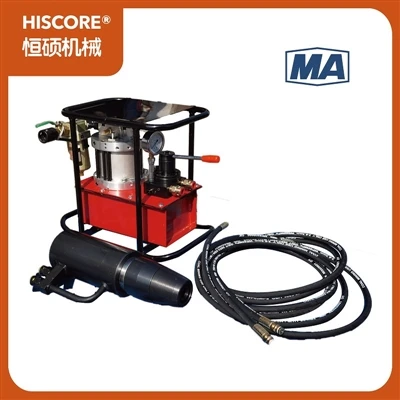
How exactly does Pneumatic Anchor Cable Tensioning work and function?
 Jul 17, 2026|
 I. Pre-operation Preparation
1. Environmental Safety Confirmation: Check that the roof of the working roadway is stable, with no risk of loose rock or rockfall, and that the underground gas concentration is ≤0.5%. Establish a warning zone to prohibit unauthorized personnel from entering.
2. Comprehensive Equipment Inspection: Confirm that the hydraulic pump station oil level is within the scale marks, the oil is clean, the tensioning jack piston extends and retracts flexibly, the high-pressure oil pipe is undamaged, and the pressure gauge is within its calibration validity period.
3. Anchor Cable Condition Verification: Confirm that the anchoring agent has solidified for ≥40 minutes, the exposed length is 150-250mm, and the surface is free of oil stains and rust.
II. Tool Installation
1. Insert the anchor clamp into the exposed end of the anchor cable and push it to the tray, ensuring the clamp is fully embedded in the slot.
2. Lift the jack and align it with the exposed end of the anchor cable, ensuring the jack is tightly against the tray and coaxial with the anchor cable to avoid uneven loading.
3. Connect the high-pressure oil pipe and tighten the quick coupling to prevent it from falling off during tensioning.
III. Tensioning Operation
1. Air Exhaust Operation: Open the pump station's unloading valve, repeatedly press the handle (manual pump) or run the electric pump unloaded for 30 seconds to expel air from the oil circuit, then close the unloading valve.
2. Pressure Increase and Tensioning: Slowly and evenly increase the pressure, gradually increasing it. Rapid impact is strictly prohibited. Stop pressurizing when the design prestress value is reached.
3. Pressure Stabilization and Holding: Maintain stable pressure for 1-2 minutes, observing that the pressure gauge does not drop and the equipment shows no leakage, ensuring the anchor cable anchoring effect meets the standards.
IV. Pressure Relief and Disassembly
1. Slowly open the unloading valve to relieve pressure. Rapid pressure relief is strictly prohibited. Stop operation after the pressure gauge returns to zero and the jack piston has fully reset.
2. First disconnect the high-pressure oil pipe connection, then remove the jack and clean the surface of the equipment of coal dust and oil stains.
3. Record the anchor cable number, tensioning pressure, pressure stabilization time, and other data, and return the equipment to the designated location.
V. Core Safety Precautions
1. The tensioning sequence should follow the principle of "tensioning from the inside out and symmetrically" to avoid stress concentration in the roof slab.
2. No personnel are allowed to stand within a 45° angle directly in front of or below the jack to prevent injury from ejected clamps.
3. Overpressure tensioning is strictly prohibited. Disassembly of oil pipes must be performed only after complete depressurization; operation under pressure is strictly prohibited.
4. In case of oil leakage, pressure drop, or other abnormalities, immediately stop work, depressurize, and troubleshoot the problem.